
Before I start my review, I would again like to thank our friends at Toymany for providing this review sample for the blog. I have really enjoyed being a Toymany collaborator for the past two years!
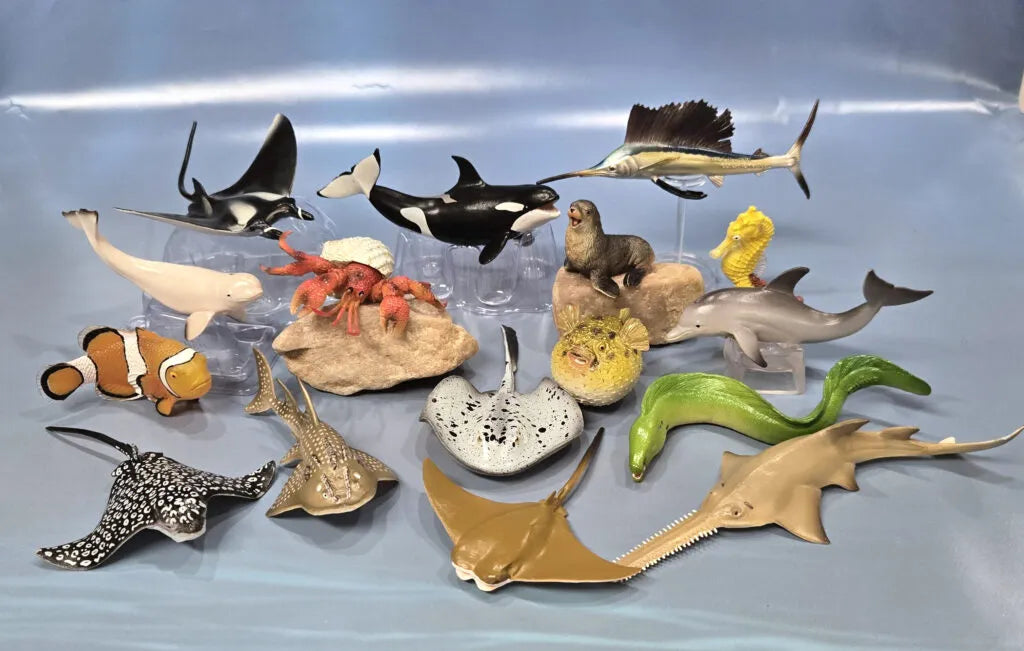
Marine animals include some of the most popular animals in our hobby, from sharks to whales and dolphins, to sea turtles. It's no wonder that many of the more well-known companies have lines and sublines devoted to them. To end 2025, Toymany added a set of 16 marine critters to its rapidly growing collection. My post today is to introduce our audience to this set. This is going to be a general overview, as some of our regular reviewers are planning in-depth reviews of individual figures! As such, my coverage for each figure will be fairly brief, focusing on identification, size, and scale, some minor biological tid-bits, and comparisons with similar figures by other companies. This is a rather long post, so let's dive right in!
We start with the lone invertebrate in the set, the hermit crab. Toymany only marketed this figure as being in the superfamily Paguroidea. Looking at promotional images, we have had some good discussions on the Animal Toy Forum as to what species it might represent. Morphologically, nothing immediately stands out as distinctive for one genus or species over another. After consideration of the morphology of the crab, I have settled on a terrestrial hermit crab in the genus Coenobita. It's also been pointed out that the mollusk shell looks like that of a turbinid snail, which are commonly used by Coenobita species. Stock footage used by Toymany on their page for this figure shows the strawberry hermit crab, C. perlatus. While that doesn't specifically imply that it is the intended species, it's good enough for my personal database! Enough of the body is exposed that I can measure the shield length (~1.0 cm) for a maximum scale of about 1:17 for C. perlatus. It could easily scale at 1:1 for a smaller specimen.

Next, we move into the fish. Having an ocean theme, it is a rather fish-heavy set. We'll start with the Chondrichthyes.
First up is the blotched fantail ray, or round ribbontail ray, Taeniurops meyeni, one of our Myliobatiformes in the set. This stingray occurs in coral reefs, estuaries, lagoons, and other coastal waters in much of the Indo-West Pacific at depths of 0–100 meters (usual range 20–60 meters). The Toymany's blotched fantail ray has a width of 6.0 cm for a scale of 1:30. The pectoral fins are sculpted undulating, so that scale might calculate differently based on measurements if it were flattened. For me, this may be the most interesting figure in the set!

Our next myliobatiform is the manta ray. Toymany doesn't market this figure at the species level on their site, but based on the color both dorsally and ventrally, I believe it best represents the giant oceanic manta ray, Mobula birostris. The pectoral fins are slightly bent upwards, but measured along the curves, the width comes to 9.5 cm for a scale of 1:42–1:74 based on a width of 4–7 meters in the actual animal. I currently have the 2018 Safari manta ray to represent this species, but I think I am going to replace it. I wasn't expecting to, but having Toymany's model in-hand, I think the paint job is much better than Safari's. I appreciate Safari's slightly larger size, but I am not that scale-conscious, so in this case, color trumps size!

The third myliobatiform is the spotted eagle ray. Spotted eagle rays in the genus Aetobatus can be variable in their spotting pattern. Toymany specifically markets this as A. narinari. With a width of wingspan of about 9.0 cm, this figure scales at 1:33. For my personal collection, I had the 2023 model by Papo to represent this species, but I think I'll swap it out for Toymany's as the spots are less uniform and the tail barbs appear to be more accurately sculpted.

Our fourth and final myliobatiform is the cownose ray, Rhinoptera bonasus. Native to the Western Atlantic, the common cownose ray is very popular in public aquariums. I am surprised there haven't been more figures of this species made for that reason! Safari Ltd. made a trio of sizes in their Incredible Creatures, Wild Safari, and Good Luck Mini lines. With a wingspan of about 8.5 cm, Toymany's cownose ray scales at about 1:29.4 for a male ray (which is based on the presence of claspers). It's a little smaller than the Safari Wild Safari model.

Our next two Chondrichthyes are members of the Rhinopristiformes. First up is the smalltooth sawfish, Pristis pectinata. The species occurs in shallow tropical and subtropical waters in both the East and West Atlantic Oceans. I was super excited for this figure as I previously only had the largetooth in my collection! Toymany advertised this figure as a juvenile, but I think it works OK as an adult. With a length of about 15.5 cm, it scales at 1:35–1:49 for an adult fish. Along with the blotched fantail ray, this was the other species I was probably most excited to see!

The other rhinopristiform is the bowmouth guitarfish, or shark ray, Rhina ancylostoma. This species isn't commonly made, and about half the figures out there are of juveniles, so it was nice for Toymany to make an adult. With a length of about 8.5 cm, this bowmouth guitarfish scales at 1:19–1:35 for an adult.

Time to move on to the five ray-finned fish in Actinopterygii.
First up is the Indo-Pacific sailfish, Istiophorus platypterus. Native to the Indo-Pacific region (hence its common name), it has become established in the Mediterranean Sea as a Lessepsian migrant. With a length of about 12.0 cm, Toymany's sailfish scales at 1:12.5–1:29, making it only about a centimeter shorter than Papo's 2020 model. I was happy with the size, as I wanted to replace the Papo model in my collection because I was never really crazy about its color. However, I have decided to repurpose the Papo figure as the Atlantic sailfish (I. albicans), which makes more sense as France-based Papo tends to go with 'local' fauna.

Next is the green moray eel, Gymnothorax funebris, a colorful eel that occurs along the Western Atlantic from New York, USA, to Brazil. This species isn't made commonly, with four by Safari Ltd.! Toymany's green moray measures 14.5 cm along the length of the body for a scale of 1:10.3–1:17.2. It's slightly smaller than, but still comparable in size to, both of Safari's Wild Safari figures (the 'bendy' and static versions).

Our third little bony fish is one of the most popular and familiar species around, the ocellaris clownfish, or common clownfish, Amphiprion ocellaris. Clownfish are known for their symbiotic relationships with venomous sea anemones. This species has been made several times by multiple Western and Japanese companies, I'm sure in part thanks to a certain Pixar film from 2003 and its sequel! Toymany's contribution to the species measures about 6.5 cm for a maximum scale of 1:17.

Next is a figure that generated some interesting discussions on our forum, the pufferfish. Toymany is marketing it as a member of the family Tetraodontidae. However, it was pointed out that the arrangement of some spines above the eyes is more suggestive of something in the family Diodontidae. I have tossed around several ideas and think for my personal collection, I am settling on the birdbeak burrfish, Cyclichthys orbicularis, based mainly on the presence of large brown macules on the dorsal half. Measuring approximately 5.5 cm, this figure scales at 1:5.5 for C. orbicularis.

Our last fish is a seahorse. Toymany only marketed it as a member of the genus Hippocampus, but it was almost certainly based on the common seahorse, H. kuda. Figures of seahorses can be inherently challenging to measure, but using trunk length (~2.5 cm) Toymany's model comes to a scale of 1:18–1:20 for H. kuda. I previously had Papo's figure representing this species, but since Papo's is more orange in color, I have decided to database it as the lined seahorse, H. erectus. Sometimes it's nice when companies are not too specific about the identity of their figures; it allows us to reassign species to diversify our collections :-).

Next, we move on to the four mammals, three cetaceans and one carnivoran, all represented by charming juveniles!
First up is a calf of the common bottlenose dolphin, Tursiops truncatus. I suppose no sealife collection would be complete without Flipper! The body length of this young dolphin measures about 10.0 cm. Because it's a juvenile, I cannot calculate a scale without knowing its precise age, but I suspect it will scale very well with many companies' standard-sized adult figures. I plan to use it as young for my 2008 Papo adult.

Next up is a calf of the killer whale, Orcinus orca. The body length measures about 11.0 cm, and like the bottlenose dolphin, I cannot really calculate a scale without knowing its age. Given the proportions, it could probably serve as an adult for those who collect smaller figures. I plan on displaying mine alongside my 2019 Safari Ltd. adult!

The last cetacean calf is that of the beluga whale, Delphinapterus leucas. The body length measures about 9.5 cm, and like the previous two, I cannot really calculate a scale without knowing its age. I plan on displaying mine alongside my 2014 Papo adult.

Last, but certainly not least, is the fur seal pup. Toymany specifically marketed this figure as a member of the genus Arctocephalus, which consists of the southern fur seals. Nearly all species occur south of the equator except for the Galapagos fur seal (A. galapagoensis) and the Guadalupe fur seal (A. townsendi). I currently don't have any members of the genus Arctocephalus in my collection, and very few standard-sized examples exist. I will probably wait until I get an adult that's identifiable at the species level, and then assign this pup as its young. The best candidate at the moment would be the Antarctic fur seal (A. gazella) by Happy Kin Toys, but it's very hard to find these days! Measuring about 3.2 cm tall and 4.0 long, this is the smallest figure in the set.

There we have it, folks, an overview of Toymany's 2025 Sea Animals Figurines Playset. Another winner in Toymany's growing resume. It offers a variety of species, from common to rare. I should also mention that most of the figures are made with a harder plastic, so there was very little warping in transit, and what little there was is easily remedied by a quick hot water treatment. This set comes recommended to general animal toy collectors and collectors of sealife specifically. Available on Toymany's website. Individual figures are also available, and there are two separate 8-piece sets (although the figures in them are not connected in any way and appear to be randomized).
Look forward to in-depth reviews of several of these figures by some of our regular reviewers!


Leave a comment
All comments are moderated before being published.
This site is protected by hCaptcha and the hCaptcha Privacy Policy and Terms of Service apply.